On This Page
- Start With What the Name Must Do
- The 12 Rules for a Strong Domain Name
- Short and Simple Wins
- The Radio Test
- Brandable vs Descriptive Names
- Choosing the Extension
- When the Name You Want Is Taken
- Thinking Long Term
- Legal and Practical Checks
- Free Registration vs a Premium Name
- Domain Names and Search Rankings
- Names for Different Kinds of Business
- Budgeting for Your Domain
- Narrowing Down Your Shortlist
- Choosing a Domain Name FAQs
Start With What the Name Must Do
Before you brainstorm, write down what the name needs to achieve. Is it for a local service, a software product, an online store or a personal brand? Who will hear it, and where? A name for a plumbing company that customers find on their phones has different needs from a name for a venture-backed startup.
A short brief keeps you honest. Note your audience, the feeling you want, any words to avoid, the markets you'll trade in and your budget for the domain. Then judge every candidate against it.
The 12 Rules for a Strong Domain Name
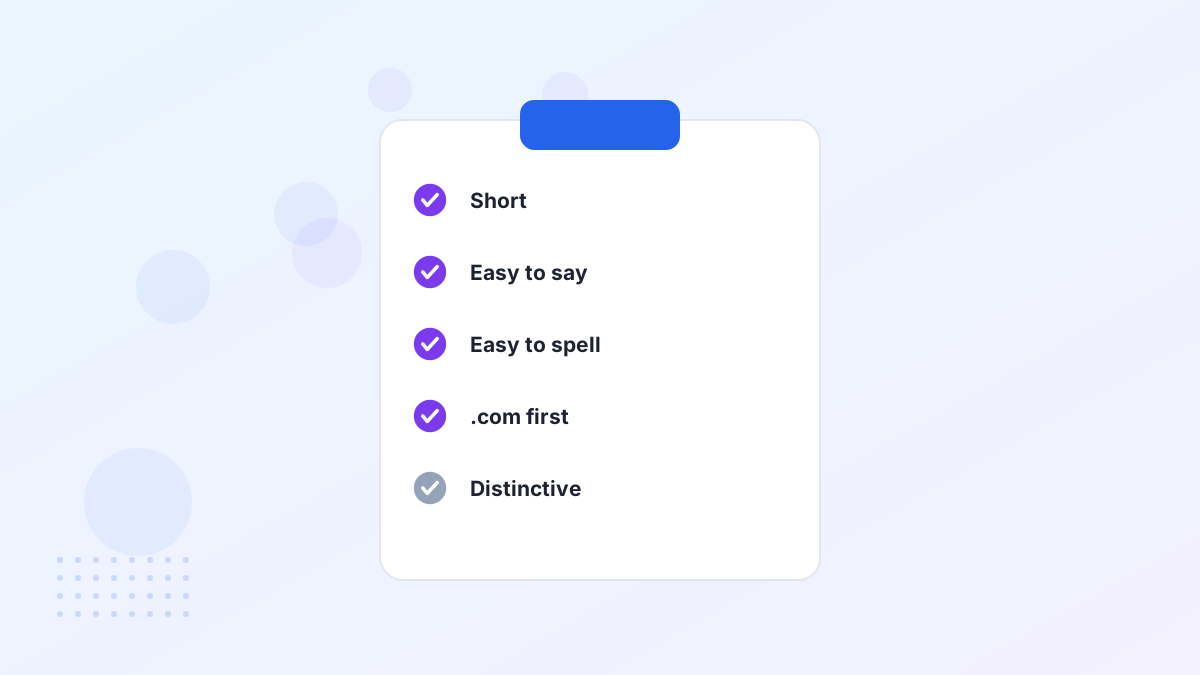
| Rule | Why it matters |
|---|---|
| 1. Keep it short | Easier to remember, type and fit on a logo |
| 2. Make it easy to say | Word of mouth only works if people can say it |
| 3. Make it easy to spell | Misspellings send visitors and email elsewhere |
| 4. Avoid hyphens | People forget them and they look less trustworthy |
| 5. Avoid numbers | "Four" or "4"? Listeners won't know |
| 6. Prefer .com | The extension most people assume |
| 7. Be distinctive | Stands out and is easier to protect |
| 8. Leave room to grow | Don't box yourself into one product or city |
| 9. Check trademarks | Avoid names you might have to give up |
| 10. Check social handles | Consistent names across platforms |
| 11. Check meanings | Avoid unfortunate meanings in other languages |
| 12. Test it | Real reactions beat your own bias |
Short and Simple Wins
There's no fixed character limit, but shorter is almost always better. One or two words, or a short invented word, is ideal. Every extra syllable is a chance for someone to forget or mistype the name.
Simple matters as much as short. A seven-letter name that's spelled exactly as it sounds beats a five-letter name with an odd spelling. If you have to explain the spelling every time, the name is working against you.
The Radio Test
Say the name out loud to someone who hasn't seen it written, then ask them to type it. If they get it right first time, it passes. If they hesitate or ask "with a K or a C?", you'll lose visitors every time the name is shared verbally, on podcasts, phone calls or at events.
Run the radio test with three people for each name on your shortlist. It takes five minutes and catches most spelling problems.
Brandable vs Descriptive Names
Says What You Do
Names like "yourcityplumbing.com". Clear immediately, but often long, hard to trademark and limiting if you expand.
Distinctive and Ownable
Invented or evocative names. Need more marketing to explain at first, but they're memorable, flexible and easier to protect.
A Bit of Both
A distinctive word plus a hint of meaning. Often the sweet spot for startups and online stores.
Local services often do well with descriptive names, because customers search for exactly what they need. Products and companies with long-term ambitions usually benefit from brandable names. Our guide to brandable vs keyword domains goes deeper.
Choosing the Extension
For most businesses, .com is still the safest choice, because it's what people type when they're unsure. Country-code extensions such as .co.uk or .de work well if you trade mainly in one country. Tech companies often use .io or .ai, which have become familiar in those circles.
If the .com of your favorite name is taken by an active business, think hard before using another extension. Some of your visitors and email will end up at the .com. See .com vs other extensions.
When the Name You Want Is Taken
Most good short .com names are already registered. That leaves you with a few options:
- Buy it from the owner if it's for sale or they're open to offers.
- Buy a premium alternative from a marketplace.
- Add a short word, like "get" or "hq", though this is usually a compromise.
- Use another extension, if the .com isn't used by a competitor.
- Pick a different name that you can own outright.
Our guide to buying a taken domain walks through the first route.
Thinking Long Term

A name that fits your first product may not fit your fifth. Avoid names tied tightly to one product, one city or a trend that may fade. Ask whether the name would still work if you expanded into new services or countries.
Changing your domain later is possible but costly. You'll need redirects, new branding and time to rebuild recognition. See rebranding to a premium domain for what that involves.
Legal and Practical Checks
- Trademark searchLook for conflicting marks in your industry. See trademark checks.
- Domain historyCheck what the domain hosted before. See domain history.
- Social handlesCheck the name on the platforms you'll use.
- Language checkMake sure the name doesn't mean something unfortunate in your markets.
- Business registryCheck whether a company already trades under the name locally.
Free Registration vs a Premium Name
If a good name is available to register at a standard price, great. Many founders find that the names they love are already owned, and the available ones are compromises. That's where premium domains come in: names already registered and offered for sale, usually at a higher price because they're shorter, more memorable or more brandable.
Whether a premium name is worth it depends on how much the name will do for you. For a business that relies on word of mouth, trust or a strong brand, it often pays for itself. See are premium domains worth it?
Domain Names and Search Rankings
A common worry is whether your domain affects search rankings. Exact-match keyword domains once carried a noticeable advantage, but search engines have long since reduced that effect. Today, rankings depend far more on your content, your site's quality and the links you earn.
What a domain still influences is behavior. A clear, trustworthy name can earn more clicks in search results, more direct visits and more brand searches over time. So choose for people first. A memorable name helps search indirectly by helping people find you again.
Names for Different Kinds of Business
| Business | Often works well | Watch out for |
|---|---|---|
| Local service | Clear descriptive names, local country extension | Names tied to one town if you'll expand |
| Startup or SaaS | Short brandable .com | Trend spellings that date |
| Online store | Memorable brand names | Names locked to one product line |
| Personal brand | Your name or a short variant | Hard-to-spell surnames without a backup |
| Content site | Topic-friendly names with room to grow | Overly long keyword strings |
Our guides for startups, online stores and personal brands go into each in detail.
Budgeting for Your Domain
A standard registration costs a small yearly fee. Premium names cost more upfront, commonly from the low thousands of dollars for brandable .coms, with renewals usually back at standard rates. Think of the domain as part of your brand budget, alongside your logo and website, rather than as a hosting cost.
If the right name is a stretch, look for listings with payment plans. They let you use the domain from the start while spreading the cost. See Atom payment plans.
Narrowing Down Your Shortlist
Aim for three to five finalists. Score each against your brief, run the radio test, check trademarks and handles, and then test the names with people in your target audience. Pick the one that performs best, not the one that's simply your personal favorite.
Choosing a Domain Name FAQs
How long should a domain name be?
As short as possible while staying clear and easy to spell. One or two words, or around six to twelve characters, is a common sweet spot.
Should a domain name include keywords?
It can help clarity for local or descriptive businesses, but keywords in the domain aren't required to rank well. Brand strength matters more for most companies.
Is .com still important?
For most businesses, yes. It's the extension people assume and trust most.