On This Page
- 1. Choosing a Name That's Hard to Spell
- 2. Using Hyphens
- 3. Using Numbers
- 4. Making It Too Long
- 5. Ignoring Trademarks
- 6. Settling for a Weak Variation
- 7. Being Too Narrow
- 8. Skipping the History Check
- 9. Forgetting Other Languages
- 10. Registering in Someone Else's Name
- 11. Letting It Expire
- 12. Weak Account Security
- 13. Not Buying Obvious Variations
- 14. Copying a Competitor's Style
- Why These Mistakes Are So Common
- Mistakes at a Glance
- Domain Mistake FAQs
1. Choosing a Name That's Hard to Spell
Creative spellings look clever on a whiteboard but fail when spoken. Every time someone hears your name and types it wrong, you lose a visitor, or worse, they end up at someone else's site. Run the radio test: say it aloud and see if people spell it right.
Instead: choose names spelled the way they sound.
2. Using Hyphens
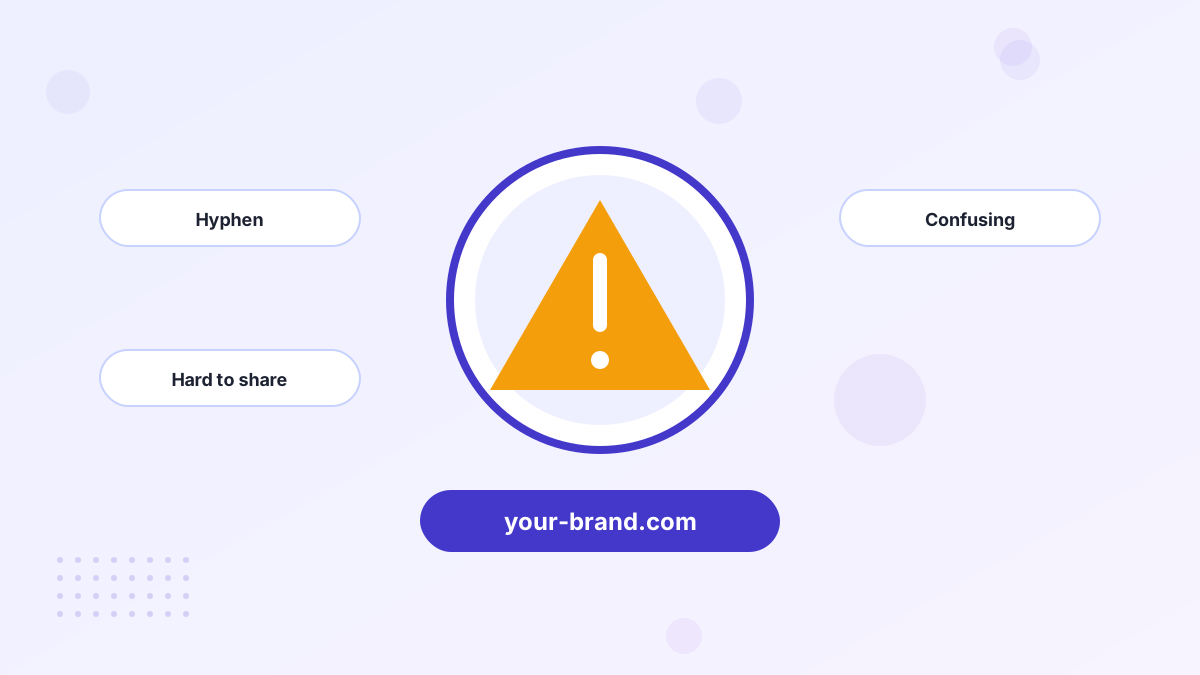
Hyphenated domains are hard to say ("your hyphen brand dot com"), easy to forget and often associated with low-quality sites. Visitors who forget the hyphen land on the unhyphenated version, which may belong to someone else.
Instead: find a name that works without punctuation.
3. Using Numbers
Is it "4" or "four"? "2" or "to"? Listeners can't tell. Numbers work only when they're part of an established brand and you own the alternatives.
Instead: avoid numbers, or buy both versions and redirect one.
4. Making It Too Long
Long domains are hard to remember and easy to mistype, especially on phones. They also look cluttered on business cards, signs and email addresses.
Instead: aim for one or two words or a short invented name.
5. Ignoring Trademarks
Building a brand on a name that conflicts with an existing trademark can force a rebrand and even cost you the domain. It's one of the most expensive mistakes because it often surfaces after you've invested in the name.
Instead: run a trademark check before buying.
6. Settling for a Weak Variation
When the .com is taken, it's tempting to add "get", "try" or "online", or use an unusual extension. Sometimes that works. But if an active business owns the plain .com, some of your traffic and email will go to them, and customers may confuse you with them.
Instead: consider buying the exact .com, or choose a different name you can own fully.
7. Being Too Narrow
"Bestwidgetsdallas.com" works until you sell gadgets, or open in Houston. Names tied to one product, place or trend can box you in.
Instead: choose a name that leaves room to grow.
8. Skipping the History Check
Domains that were used before may carry spam history, blocklist flags or links from shady sites. That can affect email delivery and search performance.
Instead: check the domain's history before buying.
9. Forgetting Other Languages
A name that sounds great in English may mean something awkward elsewhere. If you trade internationally, that matters.
Instead: ask native speakers in your key markets.
10. Registering in Someone Else's Name
It's surprisingly common for a web designer, agency or employee to register a company's domain in their own account. If they leave or the relationship sours, getting it back can be difficult.
Instead: make sure the domain is registered to your business, in an account you control. See buying domains for clients.
11. Letting It Expire
Expired domains can be caught by drop-catchers or auctioned within weeks. Losing a domain your business relies on is a disaster, and buying it back can be costly.
Instead: turn on auto-renew, renew for several years and keep contact details current. See domain renewal and expiration.
12. Weak Account Security
A hijacked registrar account can mean a hijacked domain. Weak passwords and no two-factor login make it easy for attackers.
Instead: use a strong unique password, two-factor login and the registrar lock. See protecting your domain.
13. Not Buying Obvious Variations
If your name is commonly misspelled, or a competitor could register the plural or a popular alternative extension, consider buying those too and redirecting them. It's cheap protection for valuable brands. See defensive domain registration.
Instead: pick a few key variations, not every possible one.
14. Copying a Competitor's Style
If every company in your space has a similar-sounding name, adding another makes you forgettable. Customers mix up businesses with similar names, and you may end up sending them to a rival.
Instead: study competitors' names so you can deliberately stand apart.
Why These Mistakes Are So Common
Most of these mistakes come from the same place: choosing a domain quickly because the preferred .com was taken, the budget felt tight or the launch date was close. The fix is to treat the domain as a brand decision, not a technical one, and give it the same attention as your logo or product name.
When the ideal name isn't available, a short, clean premium domain is often cheaper than years of lost visitors and an eventual rebrand.
Mistakes at a Glance
| Mistake | Cost | Fix |
|---|---|---|
| Hard spelling | Lost visitors and email | Radio test |
| Hyphens or numbers | Confusion | Clean name |
| Trademark conflict | Forced rebrand | Check first |
| Weak variation | Leaked traffic | Own the exact .com |
| Wrong registrant | Lost control | Register to your business |
| Expiry | Lost domain | Auto-renew |
Domain Mistake FAQs
Can you fix a domain mistake later?
Usually, by moving to a better domain and redirecting the old one. It costs time and money, so it's better to choose well at the start.
Are hyphenated domains bad for SEO?
Not directly, but they're harder for people to remember and share, which matters more.
What's the most expensive domain mistake?
Trademark conflicts and losing a domain to expiry or theft are usually the costliest.