On This Page
- The Short Answer
- Why .com Still Leads
- How the Main Extensions Compare
- Does the Extension Affect Search Rankings?
- The Leakage Problem
- Cost Compared
- When Another Extension Is the Better Choice
- A Common Path: Start Elsewhere, Upgrade Later
- Owning More Than One Extension
- Email Is Where Extensions Matter Most
- A Worked Example
- What Investors and Partners Notice
- How to Decide
- .com vs Other Extensions FAQs
The Short Answer
If you can get a good .com at a price that makes sense, it's still the safest default for most businesses. Choose another extension when it's genuinely common in your audience, such as .ai for AI products or a country code for a local business, and when no competitor owns the .com of the same name.
Why .com Still Leads
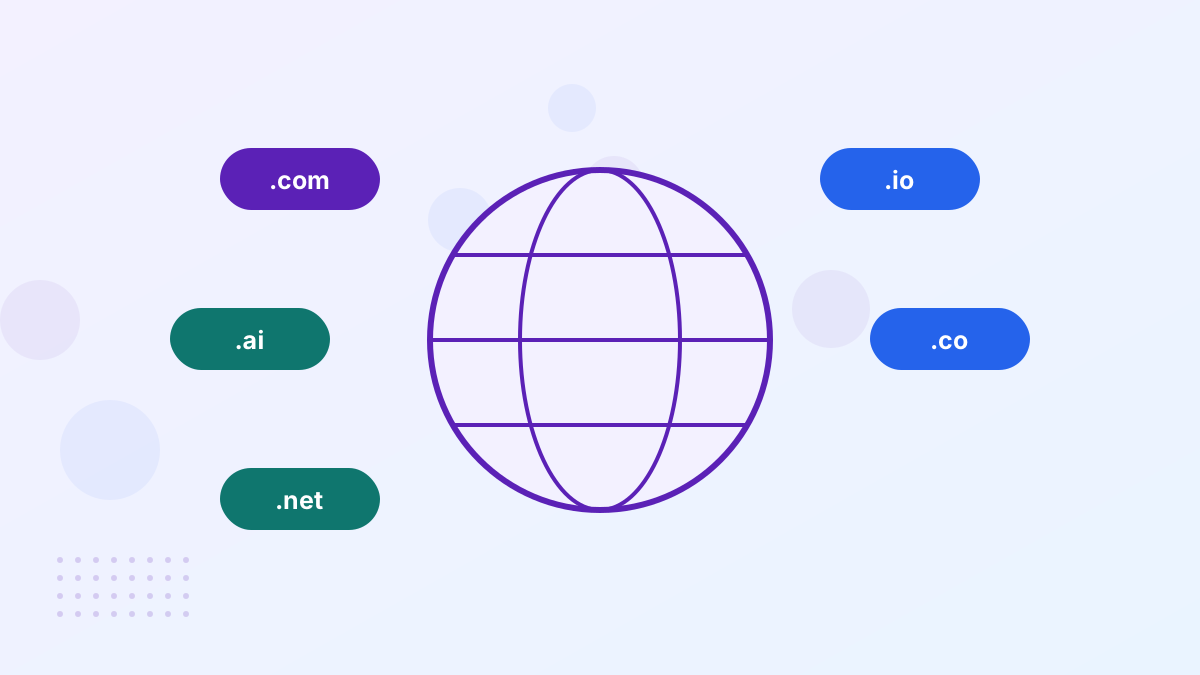
.com is the oldest commercial extension and by far the largest. Because of that, it's the one people assume. When someone hears a business name and types it into a browser, they usually add .com without thinking. When they write an email address from memory, they default to .com too.
That default is the real value. A .com captures the visitors and email that would otherwise leak to whoever owns it. It also carries a sense of establishment that many customers, partners and investors still notice.
How the Main Extensions Compare
| Extension | Best known for | Strength | Watch out for |
|---|---|---|---|
| .com | Everything | Default trust and typing | Good names are usually premium |
| .net | Networks and tech | Familiar | Traffic leaks to the .com |
| .org | Nonprofits | Trusted for causes | Odd fit for companies |
| .io | Tech startups | Recognized in tech | Higher fees; geopolitical questions |
| .ai | AI companies | Instantly signals AI | Two-year minimum; higher fees |
| .co | Startups and companies | Short and global | Easily confused with .com |
| Country codes | Local businesses | Local trust and relevance | Some have eligibility rules |
| New gTLDs | Niches like .shop or .app | Descriptive and available | Lower recognition; some high renewals |
Does the Extension Affect Search Rankings?
Not directly. Google has said it treats generic extensions equally, whether .com, .net or newer ones like .app. Country codes such as .de or .co.uk are a signal that a site targets that country. A handful of country codes that are widely used globally, including .ai, .io and .co, are treated as generic.
What the extension does influence is behavior: how readily people click your result, remember your address and come back. That's where .com tends to win.
The Leakage Problem
If you use yourbrand.io and someone else owns yourbrand.com, some of your visitors and email will end up at the .com. How much depends on your audience. Tech-savvy users who see your address written down usually get it right. Customers who hear your name on a podcast or from a friend often won't.
Leakage is worst when the .com belongs to an active business in a related field. That's both a traffic and a confusion problem, and sometimes a trademark one.
Cost Compared
A newly registered .com is cheap, but most good short .coms are already registered and sell as premium domains. Other extensions often have more available names at standard prices, though .ai and .io carry higher yearly fees than .com. Some new extensions have low first-year prices but much higher renewals.
Compare total cost over several years, not just the first-year price. A premium .com with standard renewals can cost less over a decade than a "cheap" name with high renewals plus the cost of lost traffic.
When Another Extension Is the Better Choice
You Serve One Country
A local country code like .co.uk or .de can feel more trustworthy to local customers.
Your Audience Expects It
In AI and developer tools, .ai and .io are familiar and even expected.
The .com Is Unused
If the .com is parked rather than used by a competitor, leakage is less harmful.
You're Testing an Idea
A cheaper extension can make sense for an early experiment, with a plan to upgrade.
A Common Path: Start Elsewhere, Upgrade Later
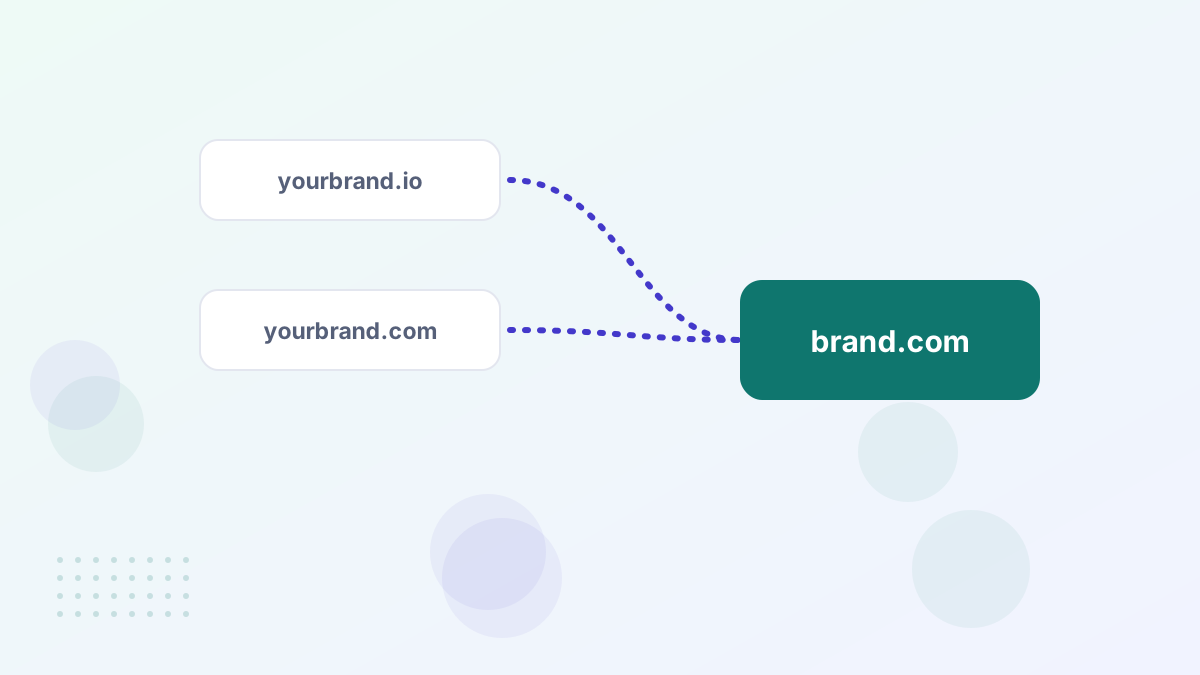
Many companies launch on .io, .ai or a variation, then buy the .com once they've grown. That's a perfectly good plan, but the .com usually gets more expensive as your brand becomes known, because the owner can see the demand. If you know you'll want the .com eventually, it can be cheaper to buy it early. See rebranding to a premium domain.
Owning More Than One Extension
Established brands often hold the .com plus their country codes and the most relevant alternatives, all redirecting to the main site. It's an inexpensive way to block lookalikes and catch mistyped visits. You don't need every extension, just the ones that matter for your market. See defensive domain registration.
Email Is Where Extensions Matter Most
Websites get found through search and links, so a less common extension can still work well online. Email is less forgiving. People type addresses from memory, phones autocomplete .com, and a single wrong character sends a message to someone else's server, or nowhere.
If your business depends on clients, suppliers or partners emailing you, the extension matters more. A .com address, or your country code in a local business, reduces bounced and misdirected mail. See business email on your domain.
A Worked Example
Imagine two founders choosing between yourbrand.ai at a standard registration price and yourbrand.com, listed for $6,500 with a payment plan. Their product uses AI, but they plan to sell to finance teams, not developers. In a quick test, most finance managers who heard the name typed .com.
They choose the .com on a payment plan and register the .ai to redirect. The .ai catches tech-savvy visitors, the .com catches everyone else, and the brand doesn't depend on customers remembering an unusual ending. For a developer tool, the same founders might reasonably have picked the .ai as the main domain.
What Investors and Partners Notice
Domain choice isn't a deciding factor for serious investors, but it's a visible signal. A clean .com suggests a company that has invested in its brand. An awkward variation or an unusual extension can raise small questions about long-term plans. It's a minor point, but founders raising money often mention it as a reason to upgrade.
How to Decide
- Check the .comWho owns it, and is it for sale?
- Consider your audienceWould they naturally type something other than .com?
- Look at competitorsWhich extensions do they use?
- Compare total costPurchase plus renewals over five to ten years.
- Weigh the risk of leakageEspecially if the .com is an active business.
.com vs Other Extensions FAQs
Is .com better for SEO?
Not directly. Search engines treat generic extensions equally. The .com advantage is in trust and memorability.
Are new extensions trustworthy?
Many are perfectly legitimate, but some audiences are less familiar with them. Consider your customers.
Should you buy the .com if you already use another extension?
If it's affordable and you're building a long-term brand, it's often worth it, even just to redirect.